
Tech
The Most Important Statistics Concepts Every Data Scientist Should Know

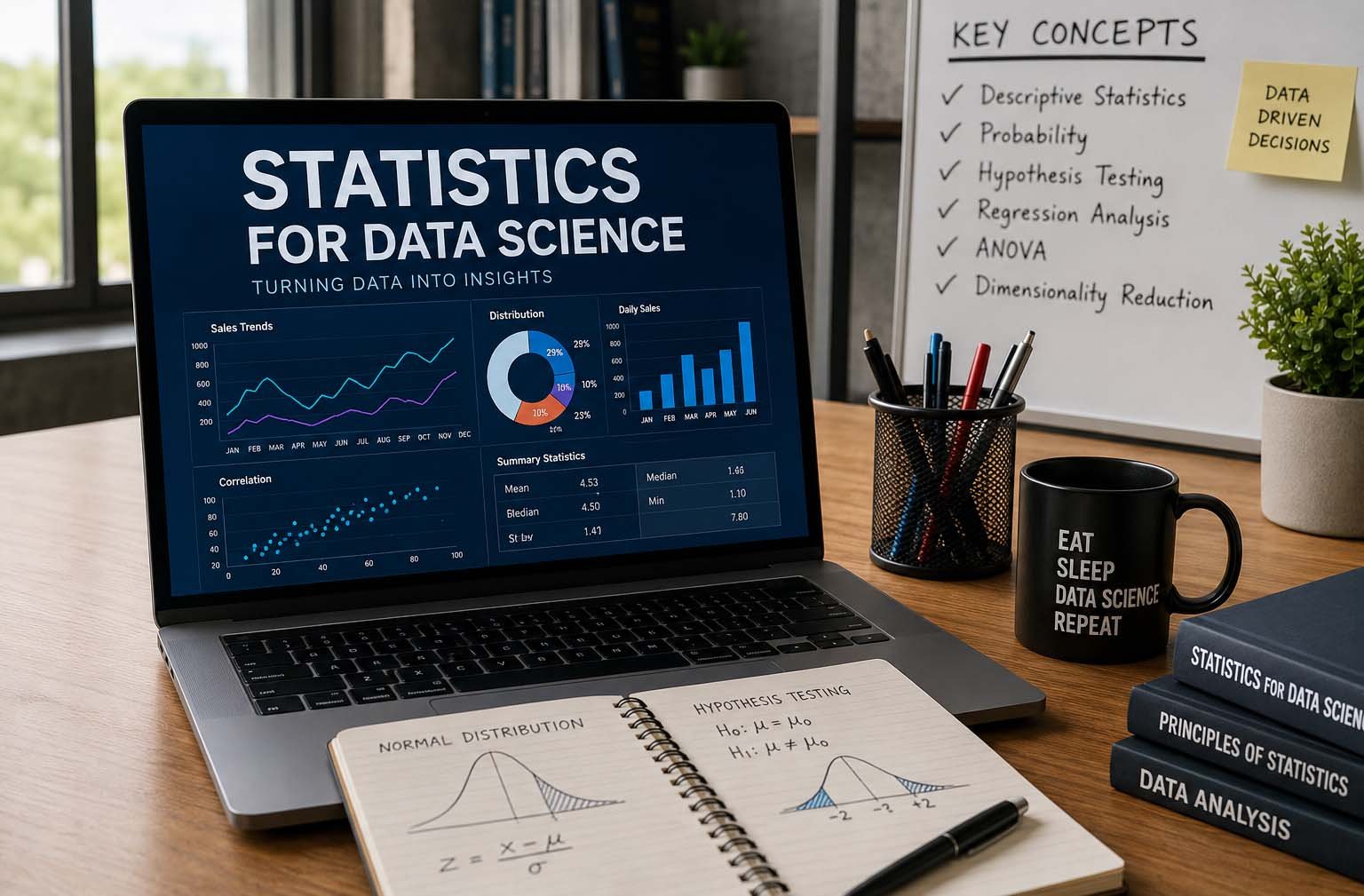
Have you ever wondered how companies know what customers may buy next? Or how apps suggest movies, songs, and products that you might like? The answer often starts with data. But data alone cannot tell a story. People need a way to understand that data. This is where statistics comes in.
Statistics for data science is one of the most important skills a data scientist can learn. It helps turn numbers into useful information. It helps people find patterns, understand trends, test ideas, and make smart decisions. Without statistics, even the biggest dataset can be difficult to understand.
Today, data is everywhere. Businesses collect customer data. Hospitals collect health data. Websites collect visitor data. Every day, huge amounts of information are created. Data scientists use statistics to study this information and find answers to important questions.
In this article, we will explore the most important statistics concepts every data scientist should know. We will use very simple words and easy examples so that anyone can understand the topic. By the end, you will see why statistics for data science is the foundation of modern data analysis and machine learning.
What Is Statistics for Data Science?
Statistics is the science of collecting, studying, and understanding data. It helps people make sense of information instead of simply looking at numbers. In data science, statistics gives meaning to data and helps turn it into useful knowledge.
Think about a business that wants to know why sales increased last month. Looking at thousands of sales records can be confusing. Statistics helps organize that information and find the reasons behind the change. It helps people see what is happening and why it is happening.
Statistics for data science is used in many tasks. It helps data scientists understand customer behavior, predict future trends, find hidden patterns, and improve business decisions. It is also used to build machine learning models that can learn from data.
Many people think data science is only about coding. While coding is important, statistics is just as important. A person may know how to write code, but without statistics, it can be hard to understand whether the results are correct or useful.
Why Statistics Is Important in Data Science
Imagine you are trying to predict tomorrow’s weather. You cannot simply guess and hope for the best. You need information from the past and a way to study that information. Statistics provides that method. It helps data scientists make predictions based on facts instead of assumptions.
One of the biggest benefits of statistics is that it helps reduce uncertainty. Real-world data is often messy and incomplete. Statistics gives tools that help people work with uncertainty and still make smart decisions. This is why it plays such an important role in data science.
Businesses depend on statistics every day. Companies use it to understand customers, improve products, and plan future strategies. Banks use it to study financial risks. Hospitals use it to improve patient care. Online stores use it to recommend products that customers may like.
Statistics is also closely connected to machine learning. Before a machine learning model can make predictions, the data often needs to be studied and prepared. Many of the methods used in machine learning come directly from statistical ideas. This is why learning statistics for data science is so valuable.
Descriptive Statistics
When data scientists first receive data, they usually want a quick summary of what the data looks like. This is where descriptive statistics becomes useful. It helps describe and summarize data in a simple and easy way.
One common measure is the mean, which many people call the average. If five students score 70, 80, 90, 85, and 75 on a test, the mean gives one number that represents the group. This makes large sets of data easier to understand.
Another important measure is the median. The median is the middle value when numbers are placed in order. Sometimes the median gives a better picture than the mean, especially when there are very large or very small values in the data.
The mode is another useful measure. It shows the value that appears most often. Data scientists also use range, variance, and standard deviation to understand how spread out the data is. These measures help show whether values stay close together or vary greatly.
Without descriptive statistics, understanding large datasets would be much harder. These simple measurements provide a strong starting point before moving to more advanced analysis.
Probability Basics
Probability is the study of chance. It tells us how likely something is to happen. In everyday life, people use probability without even realizing it. When you check the weather forecast and see a 70% chance of rain, you are looking at probability.
For data scientists, probability is extremely important because many predictions involve uncertainty. No one can know the future with complete certainty. Probability helps estimate what is most likely to happen based on available information.
Imagine an online store trying to predict whether a customer will buy a product. The store cannot know the answer for sure. However, probability can help estimate the chances of that purchase happening. This makes decision-making much easier.
Probability also helps data scientists understand risk. Businesses often need to know what could go wrong and how likely it is to happen. By studying probability, they can prepare for different situations and make better choices.
Because so much of data science involves predictions, probability remains one of the most important building blocks in statistics for data science.
Probability Distributions
Probability distributions help show how data is spread across different values. They tell us which outcomes are common and which outcomes are rare. This gives data scientists a better understanding of how data behaves.
Think about the heights of people in a city. Most people may be close to an average height, while very short and very tall people may be less common. A probability distribution helps show this pattern clearly.
One of the most common distributions is the normal distribution. It often looks like a bell-shaped curve. Many real-world measurements, such as heights, weights, and test scores, tend to follow this pattern. Data scientists frequently use this distribution when analyzing data.
Other important distributions include the binomial distribution and the Poisson distribution. These are useful for studying different types of events and outcomes. Each distribution helps answer different kinds of questions depending on the data being studied.
Probability distributions are also used when testing ideas, building models, and making predictions. They help data scientists understand what values are likely to appear and what values might be unusual.
Sampling and Data Collection
In a perfect world, data scientists would study every piece of data available. In reality, this is often impossible. Some datasets are simply too large. This is why sampling is such an important concept.
A sample is a smaller group taken from a larger population. Instead of studying millions of customers, a company may study a smaller group that represents the larger audience. This saves both time and money.
Good sampling is very important because poor samples can lead to incorrect conclusions. If a sample does not represent the full population, the results may be misleading. This problem is known as sampling bias.
Data collection is just as important as sampling. Even the best statistical methods cannot fix poor-quality data. Data scientists must collect information carefully and make sure it is accurate, complete, and reliable.
When data is collected correctly and samples are chosen fairly, the results become much more trustworthy. This creates a strong foundation for every other step in the data science process.
Hypothesis Testing
Now that we understand how data is collected and studied, the next step is learning how data scientists test ideas and check whether their findings are truly meaningful.
This is where hypothesis testing becomes one of the most powerful tools in statistics for data science. It helps answer an important question: Are the results real, or did they happen by chance?
In the next part of this article, we will explore hypothesis testing, confidence intervals, correlation and causation, regression analysis, ANOVA, dimensionality reduction, PCA, and other important concepts that every data scientist should understand.
Hypothesis Testing
Hypothesis testing is a way to test an idea using data. It helps data scientists check if something is likely true or if it only looks true because of chance. This is very useful in real work because businesses often need proof before making a big change.
For example, a company may want to know if a new website design brings more sales. They can test the old design against the new design. Hypothesis testing helps them see if the new design really works better or if the result happened by luck.
There are two main ideas in hypothesis testing. The first is the null hypothesis. This usually means there is no real change or no real difference. The second is the alternative hypothesis. This means there is a real change or real difference.
Data scientists also use a p-value in this process. A p-value helps show how strong the result is. If the p-value is very small, it may mean the result is important. This is why hypothesis testing is a key part of statistics for data science.
Confidence Intervals
A confidence interval gives a range of likely answers. It does not give only one number. This is helpful because data is rarely perfect. A range can show how sure we are about an answer.
For example, a company may ask 500 customers if they like a new app. The result may show that 80% of people like it. But the real number for all users may not be exactly 80%. A confidence interval may say the answer is likely between 76% and 84%.
This helps data scientists explain results more clearly. It also reminds people that every result has some level of doubt. Good data work does not hide doubt. It shows it in a clear and honest way.
Confidence intervals are used in surveys, business reports, health studies, product tests, and market research. They help people make better choices because they show both the answer and the possible range around that answer.
Correlation and Causation
Correlation means two things move together in some way. For example, ice cream sales and hot weather may rise at the same time. This means they have a relationship. But it does not always mean one thing directly causes the other.
Causation means one thing actually causes another thing to happen. Hot weather may cause more people to buy ice cream. But if two numbers rise together, we should not quickly assume that one caused the other.
This is a very important lesson in data science. A data scientist may find that two things are linked, but they still need to ask more questions. Is there a real cause? Or is another hidden factor involved?
Understanding correlation and causation helps avoid wrong decisions. In statistics for data science, this concept is very important because wrong links can lead to wrong business plans, weak models, and poor predictions.
Regression Analysis
Regression analysis helps data scientists study the relationship between different things. It can show how one factor may affect another. It is also used to make predictions from past data.
For example, a house price may depend on size, location, number of rooms, and age of the house. Regression can help show which factors matter most. It can also help guess the price of a new house based on these details.
Linear regression is one of the most common types. It studies a straight-line relationship between two things. Multiple regression is used when there is more than one input. Non-linear regression is used when the relationship is not straight or simple.
Regression is also used in machine learning. Many prediction models are based on the same idea. This makes regression one of the most useful concepts in statistics for data science and data analysis.
ANOVA and Group Comparison
ANOVA means Analysis of Variance. It is used when data scientists want to compare more than two groups. It helps check if the difference between groups is real or if it may have happened by chance.
For example, a company may test three marketing campaigns. Campaign A, Campaign B, and Campaign C may all bring different results. ANOVA can help show if one campaign truly worked better than the others.
This is useful because comparing groups is common in data science. Businesses compare products, prices, ads, customer groups, website pages, and many other things. ANOVA gives a clean way to study these differences.
ANOVA also helps understand variation in data. Some variation is random. Some variation comes from real causes. A data scientist needs to know the difference so they can explain results in a fair and useful way.
Dimensionality Reduction and PCA
Many datasets have too many features. A feature is simply a piece of information used in the data. For example, a customer dataset may include age, city, past orders, clicks, time spent, and many more details.
Too many features can make data harder to study. It can also slow down machine learning models. Some features may repeat the same idea. Some may not be useful at all. Dimensionality reduction helps solve this problem.
Dimensionality reduction means reducing the number of features while keeping the most useful information. This makes the data simpler, cleaner, and easier for models to understand.
PCA, or Principal Component Analysis, is one popular method. It combines related features and creates new, cleaner features. PCA can also help reduce multicollinearity, which happens when some features are too closely linked.
This method is used in clustering, anomaly detection, and natural language processing. In fraud detection, it can help find strange patterns. In text data, it can help systems understand words and meaning more clearly.
A/B Testing
A/B testing is a simple and powerful way to compare two choices. One group sees version A. Another group sees version B. Then the data is studied to see which version performs better.
For example, an online store may test two button colors. One button may say “Buy Now.” Another may say “Get Yours Today.” A/B testing can help show which one gets more clicks or more sales.
This method uses ideas from hypothesis testing and probability. It helps businesses make choices based on real user behavior, not just personal opinion. That is why it is common in marketing, apps, websites, and product design.
A/B testing is one of the most practical uses of statistics for data science. It turns small tests into useful lessons. These lessons can help improve user experience, sales, sign-ups, and customer satisfaction.
Statistics in Machine Learning
Statistics and machine learning are closely connected. Machine learning models learn from data, but statistics helps data scientists understand that data first. Without statistics, it is hard to know if a model is doing well or making mistakes.
Statistics helps with data cleaning, feature selection, model testing, error checking, and result reading. It also helps data scientists understand why a model gives a certain answer.
For example, a model may predict which customers are likely to leave a service. Statistics can help check if the model is accurate. It can also help find which customer habits are most important for the prediction.
In 2026, data science, AI, and machine learning are growing fast. But the need for statistics is still strong. Good tools can help, but a smart data scientist still needs to understand the numbers behind the tools.
Common Mistakes Beginners Make
One common mistake is trusting data without checking it. Data can be missing, wrong, old, or unfair. If the data is poor, the results will also be poor. Clean data is always the first step.
Another mistake is thinking correlation means causation. Just because two things happen together does not mean one caused the other. A good data scientist always asks more questions before making a claim.
Some beginners also focus only on tools and coding. Tools like Python, R, Excel, SQL, and data dashboards are useful. But tools are not enough. The person using the tool must understand the statistical ideas behind the result.
Another common mistake is ignoring uncertainty. Data science is not about perfect answers all the time. It is about better answers, clearer thinking, and smarter choices. Statistics helps make those choices more honest and useful.
Best Tools for Statistics in Data Science
Python is one of the most used tools in data science. It has useful libraries like pandas, NumPy, SciPy, statsmodels, and scikit-learn. These tools help with data cleaning, statistics, charts, testing, and machine learning.
R is another strong tool for statistics. Many researchers, analysts, and data scientists use R because it is made for data study and statistical work. It is very helpful for reports, charts, and deep data analysis.
SQL is also important because data is often stored in databases. A data scientist must know how to collect and filter data before studying it. Excel and Google Sheets are also useful for smaller tasks and simple reports.
The best tool depends on the work. But the main idea is simple. Tools help you work faster, but statistics helps you understand what the results really mean.
Final Thoughts
Statistics is one of the strongest skills a data scientist can learn. It helps turn raw data into clear meaning. It also helps people make better choices instead of guessing.
The most important statistics concepts include descriptive statistics, probability, distributions, sampling, hypothesis testing, confidence intervals, correlation, regression, ANOVA, and dimensionality reduction. Each one helps in a different part of data science.
Statistics for data science is not just a school topic. It is used in business, health, banking, shopping apps, websites, marketing, AI, and machine learning. It helps people understand what is happening and what may happen next.
If you are new to data science, start slowly. Learn one concept at a time. Use easy examples. Practice with real data. Over time, these ideas will become much easier and much more useful.
In the end, good statistics skills can make you a better data scientist. They help you ask better questions, trust results carefully, and build smarter data-driven solutions.
(FAQs)
What is statistics for data science?
Statistics for data science means using statistical methods to understand data. It helps data scientists find patterns, make predictions, test ideas, and make better decisions from numbers.
Why is statistics important for data scientists?
Statistics is important because it helps data scientists understand data clearly. It also helps them avoid wrong results, test ideas, measure risk, and build better machine learning models.
What statistics concepts should a data scientist learn first?
A beginner should first learn mean, median, mode, variance, standard deviation, probability, distributions, sampling, hypothesis testing, correlation, regression, and confidence intervals.
Is statistics hard for data science beginners?
Statistics can feel hard at first, but it becomes easier when explained with simple examples. Beginners should learn one topic at a time and practice with real data.
Is statistics used in machine learning?
Yes, statistics is used in machine learning. It helps with model training, testing, prediction, error checking, and understanding how reliable the model results are.
What is the best way to learn statistics for data science?
The best way is to start with basic ideas, use simple examples, and practice with real datasets. Python, R, Excel, and online data projects can help a lot.
Do data scientists need advanced statistics?
Yes, advanced statistics is helpful for many data science jobs. Topics like regression, ANOVA, PCA, hypothesis testing, and probability distributions help data scientists solve deeper problems.
Don’t miss these:
What Is Chi-Square Test? Explanation for Everyone
Gramhir.pro Explained: What It Is and How It Creates AI Images

How to Battery-Proof a Cashless Day Out

Permanent Christmas Lighting: The Upgrade Your Home Deserves

CFA Course Duration vs Career Advancement: Long-Term Perspective

When Your AC Breaks Down, Every Hour Counts

Why Power Washing Is the Best Thing You Can Do for Your Property This Season

When Your Furnace Fails, Fast Help Makes All the Difference

When Your Toilet Breaks, You Need More Than a Quick Fix

Beyond the Thermal Baths: A Surprising Reason to Visit Hungary

How to Create the Perfect Gift Box: Tips, Ideas & Inspiration

How the Best Chronic Care Management Software Supports Care Coordination?

Best Video Doorbell Without Subscription Storage Guide

How to Build and Scale an SEO Agency Without Spending Thousands on Tools

How Dissertation Writer AI Assists Students From Topic Selection to Completed Dissertation

Why Renting a Private Home Near an Active Volcano Is Safer Than You Think

Men’s Western Shirts Ideas: 3 Styling Formulas for a Cool Summer

MacBook Air Computer Charger: Features, Performance, and Computer Charger MacBook Compatibility Guide

Desktop Essentials: Why Custom Printed Notepads Never Go Out of Style

When Connectivity Counts, Telecommunications Contractors Deliver

Why Students Prefer Expert TEAS Exam Assistance Over Solo Prep

How to Get the Best Price for Your Used Car Without Guessing Its Value
How to Battery-Proof a Cashless Day Out
Permanent Christmas Lighting: The Upgrade Your Home Deserves
CFA Course Duration vs Career Advancement: Long-Term Perspective
When Your AC Breaks Down, Every Hour Counts
Why Power Washing Is the Best Thing You Can Do for Your Property This Season
When Your Furnace Fails, Fast Help Makes All the Difference
When Your Toilet Breaks, You Need More Than a Quick Fix
Beyond the Thermal Baths: A Surprising Reason to Visit Hungary
How to Create the Perfect Gift Box: Tips, Ideas & Inspiration
How the Best Chronic Care Management Software Supports Care Coordination?
-

 Biography5 months ago
The Emotional Journey of Joanne Schieble Simpson, Steve Jobs’ Biological Mother
-

 News4 months ago
Jamal Adeen Thomas – Everything You Should Know About Clarence Thomas’ Son
-

 Biography5 months ago
Meet Theo Ressler: Everything You Know About Jami Gertz’s son
-

 Blog1 month ago
What Is Sotwe? Everything You Need to Know Before Using It