If you’re a CTO in 2026, you’ve probably had this conversation more times than you can count. Someone on the leadership team asks, “Why are we paying $80K a year for this tool when we could just build it?” And then someone else says, “Why are we spending six months building something we could launch in a week?” Both of them are right. That’s exactly what makes the custom software vs SaaS decision so frustrating and so consequential.
This isn’t a theoretical debate anymore. With AI reshaping what software can do, compliance pressure mounting across US industries, and vendor pricing getting less predictable every year, the stakes of getting this wrong are higher than they’ve ever been. Navigating a high-stakes custom software vs SaaS decision requires balancing rapid deployment goals against long-term operational autonomy.
The CTO Decision in 2026: Why Build vs Buy is Harder Than Ever
A few years ago, the build-versus-buy framework was simpler. SaaS was cheaper upfront; custom was better long-term. Pick your priority, and move on. Today? The variables have multiplied, turning procurement into a highly complex enterprise software decision-making puzzle.
Enterprise tech stacks are layered in ways that create real friction. You’ve got legacy systems talking to cloud infrastructure talking to third-party APIs, and every new SaaS tool you add is another integration point that can break, another contract that can change, another vendor whose roadmap you don’t control. This architectural friction forces technology leaders to treat every implementation as a major enterprise software decision-making exercise rather than a simple software purchase.
AI has changed software expectations overnight. Tools that felt cutting-edge in 2023 feel limited now because they weren’t built with AI workflows in mind. And compliance, especially in healthcare, finance, and logistics, has gotten specific enough that off-the-shelf software often can’t meet requirements without significant customization anyway.
The result? Most forward-thinking CTOs aren’t choosing between SaaS and custom anymore. They’re designing hybrid architectures. But you still need a framework for deciding what lives where.
Key Factors CTOs Use to Compare SaaS and Custom Software
Evaluating your options requires looking past marketing promises and analyzing core architectural needs across several key operational areas.
Total Cost of Ownership (TCO) Over 3–5 Years
This is where a lot of enterprise software decision-making goes wrong. Teams look at Year 1 SaaS costs versus Year 1 custom development costs, and SaaS wins easily. But that comparison breaks down fast.
A SaaS platform at $30K/year sounds reasonable until you’re at $150K in Year 5, with per-seat pricing that scales against you as your team grows, plus add-ons you didn’t anticipate needing. This commercial volatility is why modern enterprise software decision-making prioritizes cost predictability over low initial fees. Custom software has front-loaded costs; development, testing, and infrastructure setup, but the ongoing cost structure is fundamentally different. You’re paying for maintenance and iteration, not for access.
The honest answer is that the total cost of ownership SaaS vs custom doesn’t favor one universally. It depends on how core the function is, how fast your usage will grow, and how much you’ll need to customize the SaaS tool to fit your actual workflows. If you’re heavily customizing a SaaS product, you’re often paying twice, once for the license, once for the workarounds, which skews the entire custom software vs SaaS decision over a five-year horizon.
Time to Market and Competitive Pressure
SaaS wins here, full stop, for most use cases. If you need a CRM, an HR platform, or a marketing automation tool, you’re not going to out-engineer Salesforce or HubSpot in a reasonable timeframe. The ecosystem, integrations, and support infrastructure that come with mature SaaS products represent years of development you’d be replicating from scratch.
But time to market cuts both ways. If your product’s core value proposition depends on a capability that no SaaS vendor offers, or that you’d have to bolt together from five different tools, then the speed advantage of SaaS disappears. You end up slow anyway, just with more vendor dependencies. Custom software ROI for enterprises often materializes precisely in these differentiated use cases, where what you’re building is the product, not just supporting it.
Scalability and Performance Requirements
SaaS platforms are built to scale, but they’re built to scale for the average customer, not your specific load patterns. If your usage is relatively predictable and fits the vendor’s assumptions, this is fine. If you have unusual peak loads, complex data relationships, or processing requirements that sit outside the norm, you’ll start hitting walls, rate limits, data export restrictions, and performance degradation that no amount of money can fully solve.
Custom systems, built with your actual architecture in mind, handle these edge cases better. The tradeoff is that you own the scaling problem. But for enterprises with serious technical requirements, that ownership is often worth it.
Security, Compliance, and Data Control
SaaS vendor lock-in risks get most of the attention, but data control is just as important, and more urgent in regulated industries. HIPAA, SOC 2, state-level privacy laws, and the growing overlap with GDPR frameworks for US companies with international operations mean that “the vendor handles security” isn’t a sufficient answer anymore.
When a patient record, a financial transaction, or a customer’s personally identifiable information lives in a SaaS platform, your compliance posture depends on that vendor’s controls, audit trails, and breach response. You can negotiate DPAs and BAAs, but you can’t negotiate away the fundamental reality that you don’t control the infrastructure.
Custom software keeps sensitive data in environments you own and configure. For companies operating in healthcare, fintech, or enterprise B2B where data residency matters, this isn’t optional; it’s the deciding factor that instantly settles the custom software vs. SaaS decision.
Vendor Lock-in vs Full Ownership
The SaaS vendor lock-in risks conversation has gotten more serious as companies have experienced what happens when a vendor changes pricing, gets acquired, or sunsets a feature you depended on. It’s not hypothetical anymore; it’s happened to enough teams that it factors into procurement decisions from the start.
Lock-in isn’t just about data portability, either. It’s about workflow dependency. When your team’s processes are built around a specific tool’s UX and logic, switching becomes an organizational change management problem, not just a technical one. That switching cost is real leverage that vendors use at renewal time, which heavily penalizes poor enterprise software decision-making down the line.
Custom software eliminates that leverage entirely. You own the codebase, the data, and the roadmap. The risk shifts; now you’re dependent on your internal team or your development partner, but it’s a risk you can manage directly.
When CTOs Choose SaaS vs When They Build Custom Software
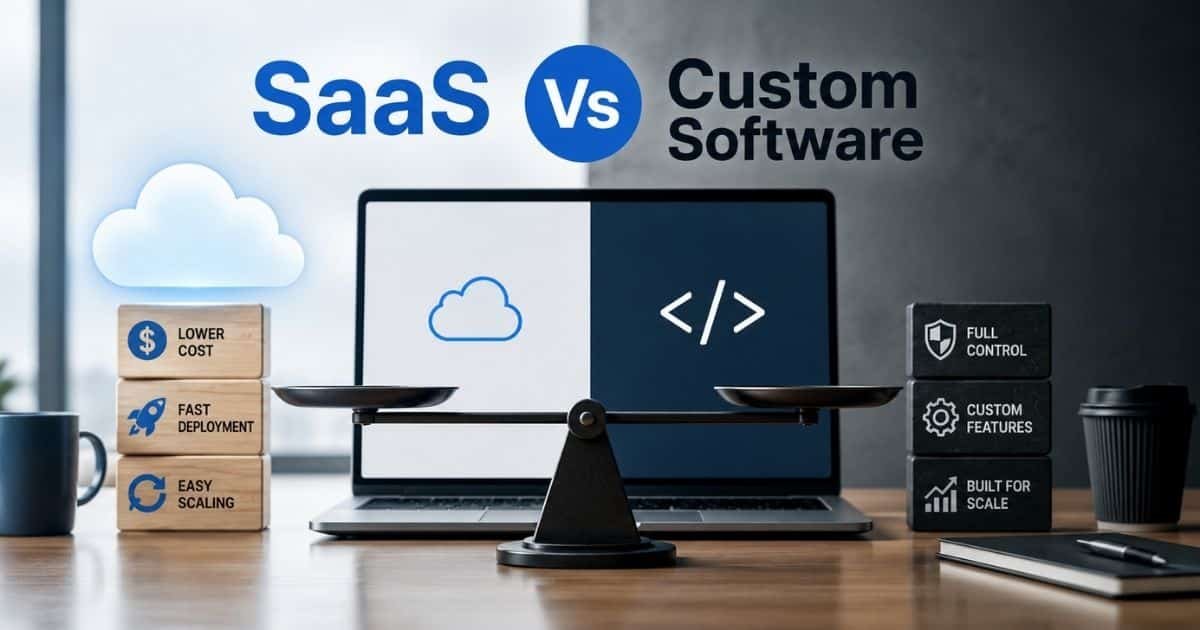
The practical pattern in 2026 looks something like this: SaaS for the commodity layer, custom for the competitive layer.
CRMs, HR platforms, accounting software, and email tools, these are solved problems. The efficiency gains from building your own version don’t justify the cost. SaaS wins.
Core business logic, proprietary data pipelines, customer-facing product features, anything that directly drives revenue or differentiation, this is where custom software earns its place. A fintech company’s risk-scoring model, a healthcare platform’s patient-matching algorithm, and a logistics company’s routing engine should live in custom tools rather than a rigid SaaS application. They’re too central to what makes the business valuable.
The CTO technology strategy 2026 that’s actually working is hybrid: a SaaS foundation for standard operations, with custom layers built on top for the things that matter competitively. Resolving the custom software vs SaaS decision this way allows you to optimize capital allocation across your entire system. Teams working with experienced custom software partners, like the engineering teams at Unique Software Development, who specialize in building these differentiated layers, are finding that the right combination beats either extreme.
The decision triggers are consistent across industries: scale stage, data sensitivity, integration complexity, and how much of your product is the software itself. When any of those factors tips past a certain threshold, the build vs buy software framework shifts toward custom, demanding a structural evolution in your enterprise software decision-making methodology.
Conclusion
The custom software vs SaaS decision in 2026 isn’t really a binary anymore. The CTOs making smart calls are the ones who’ve stopped asking “which one?” and started asking “which parts of our stack need to be ours?” SaaS has genuinely earned its place; it’s faster, well-supported, and often the right answer for functions that aren’t core to your competitive position.
But for the things that matter, the workflows that drive revenue, the data that needs to stay yours, the capabilities that no vendor has built yet, custom software still wins. The key is knowing the difference and building an architecture intentional enough to honor both realities at once.
If you’re working through this decision for your organization, exploring enterprise custom software development services is worth the conversation before you sign another multi-year SaaS contract you might later regret.





 Biography7 months ago
 News7 months ago
 Blog4 months ago
 Biography7 months ago