Business
Why Honest Writers Keep Getting Flagged by AI Checkers
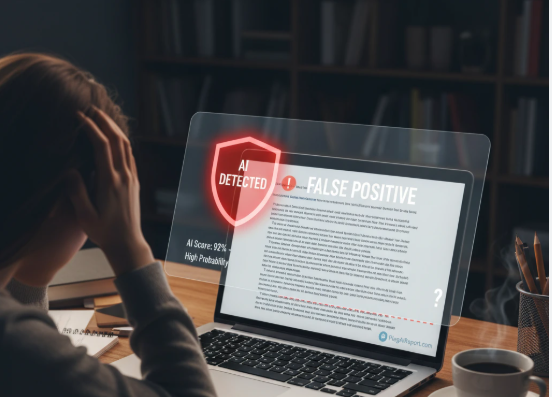
You wrote every word yourself. You ran it through a checker anyway, just to be safe. It came back “85% AI.” Now you’re defending work you actually did.
This happens constantly, and it isn’t rare bad luck. AI detectors misfire on genuine human writing at rates that should alarm anyone who relies on them. The people flagged most often are frequently the ones who did nothing wrong.
Understanding why is the first step to protecting yourself. The problem lives in how these tools work, not in how you write.
How AI Checkers Actually Decide
Two Numbers Do Most of the Work
Detectors don’t read for meaning. They score text on statistical patterns, mainly two of them: perplexity and burstiness.
Perplexity measures how predictable your words are to a language model. If your phrasing is easy for the model to guess, the tool reads that as machine-like. Burstiness measures variation in sentence length and structure.
Why That Logic Backfires
Here’s the trap. Clear, well-organized human writing is often low perplexity, because good writers use direct, expected phrasing on purpose. Clean prose can look artificial to a detector.
As one 2026 analysis explained, neurodivergent writers can produce text that reads as either too uniform or too unusual, and both extremes trip the same alarms. The tool isn’t judging whether a human wrote it. It’s judging whether the writing looks average enough.
Who Gets Flagged the Most
Non-Native English Speakers
The bias here is documented and severe. A landmark Stanford study by Liang and colleagues, published in the journal Patterns, found that over 61% of TOEFL essays written by non-native English speakers were falsely classified as AI, while native-speaker essays were judged almost perfectly.
The disparity has not gone away. A 2026 follow-up reported a mean false-positive rate of 61.3% for essays by Chinese students, compared with just 5.1% for US students under identical conditions. Detectors penalize the simpler grammar and vocabulary common among English learners.
Neurodivergent Writers
The same machinery hits neurodivergent writers hard. Research from the University of Nebraska-Lincoln found higher false-positive rates among students with ADHD and autism.
The reason is structural. Writers who use consistent, repetitive patterns, or who draft in focused bursts, produce exactly the statistical signatures detectors link to AI. Their natural voice becomes the evidence against them.
Even Experienced Professionals
This isn’t only a student problem. A 2026 report noted that some professors saw their own lecture notes and research proposals flagged as AI, simply because the writing was formal, repetitive, or heavy on specialized terms.
Freelancers have lost contracts and had payments withheld over false flags, even when they could prove authorship with drafts and timestamps. Honest work, real consequences.
The Reliability Problem Runs Deep
The Tools Contradict Themselves
Vendor accuracy claims and independent tests often don’t match. Turnitin has stated its AI checker has a false-positive rate under 1%, yet a Washington Post test produced a rate closer to 50%, albeit on a smaller sample.
The skepticism goes to the top. OpenAI, the maker of ChatGPT, quietly shut down its own AI-detection classifier in July 2023, citing its low accuracy. The company that builds the AI couldn’t reliably detect it.
Institutions Are Backing Away
Universities are drawing conclusions from this. UCLA declined to adopt Turnitin’s AI detection across its campus over accuracy and equity concerns, and the University of Waterloo discontinued Turnitin’s AI detection in September 2025, citing bias against non-native speakers.
The legal stakes are rising too. A Yale student sued in 2025 after a detector flag led to suspension, and a University of Michigan case in 2026 challenged a false accusation. Courts are signaling that a detector score alone isn’t proof of anything.
What Honest Writers Can Actually Do
Check Before Someone Else Does
You can’t control which tool an editor or instructor uses, but you can see roughly how your writing scores before you submit it. Running your own work through a checker turns a nasty surprise into information you can act on.
This is a fair, legitimate use of the technology. An AI detector is a tool that analyzes a piece of text and estimates how likely it is to have been machine-generated, based on the same statistical patterns, like word predictability and sentence variation, that institutional checkers rely on. Used on your own writing, it works as an early-warning system rather than a verdict. If your genuine draft scores high, that tells you a detector somewhere might misread it, and you can respond in advance: keep your dated drafts, note where your natural style is unusually uniform, and be ready to show your process. The value here is not gaming a score. It is seeing your work the way an automated tool will see it, so a false flag never catches you flat-footed. Because false-positive rates vary widely between tools, checking against a detector that aims for a low false-positive rate gives you a more honest read than the free checkers known for over-flagging.
Keep Proof of Your Process
Your best defense is a paper trail. Version history, timestamps, and messy early drafts are hard to fake and easy to show.
Write in an environment that saves revision history automatically. If you’re ever questioned, the evolution of a document from rough notes to finished piece is powerful evidence a machine can’t produce.
False Positives at a Glance
| Group | Approximate false-positive risk | Root cause |
| Native English speakers | Low | Matches detector’s “human” baseline |
| Non-native speakers | Very high (61%+ in studies) | Simpler grammar and vocabulary |
| Neurodivergent writers | Elevated | Uniform or unusual patterns |
| Formal or technical writers | Moderate | Repetitive, jargon-heavy phrasing |
The pattern across that column is uncomfortable. Detectors punish anyone whose writing sits outside a narrow statistical middle.
Pro tip: If your honest work gets flagged, don’t panic or rewrite it into something worse. Calmly share your draft history and point out that detector scores carry documented false-positive rates above 60% for some groups. Evidence and context beat a single number every time.
The Takeaway
Honest writers keep getting flagged because AI checkers judge patterns, not authorship. They reward high-variance, unpredictable prose and penalize the clear, formal, or consistent writing that millions of real people produce.
The research is blunt about it. False-positive rates cross 60% for non-native speakers, run high for neurodivergent writers, and have pushed major universities to abandon these tools.
Protect yourself with two habits: check your own work before others do, and keep proof of how you made it. A detector’s guess should never outweigh the evidence of the person who actually wrote the words.
-
Biography4 months agoThe Emotional Journey of Joanne Schieble Simpson, Steve Jobs’ Biological Mother
-

News4 months agoJamal Adeen Thomas – Everything You Should Know About Clarence Thomas’ Son
-
Biography4 months agoMeet Theo Ressler: Everything You Know About Jami Gertz’s son
-
Tech3 months agoBynethi com Explained Clearly: Benefits, Risks, and What to Expect