
Blog
The OrcaRouter Model Catalogue: 200+ Models Behind One OpenAI-Compatible Key

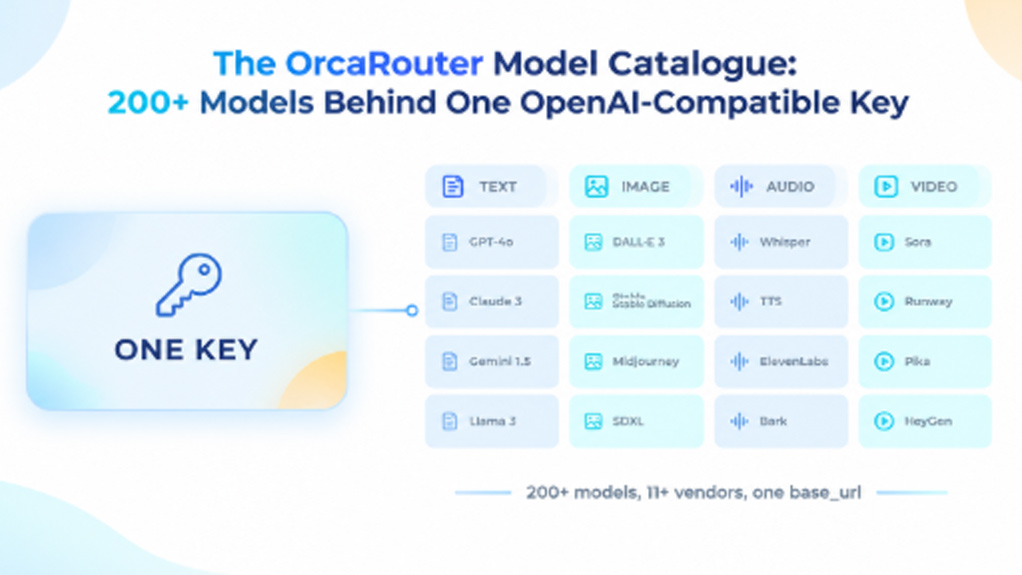
A catalogue that opens on a row count instead of an adjective is unusually easy to argue with, which is the point. The OrcaRouter model catalogue carries 200+ models from 11+ vendors — OpenAI, Anthropic, Google, AWS Bedrock, Azure, Mistral, Meta Llama, DeepSeek, Qwen, Moonshot Kimi and ByteDance Seedance — and the AI API surface is the view that makes that list priceable: one OpenAI-compatible key, one base_url, one table you can narrow by provider, context window and price.
The number that actually matters here is not 200. It is one. One key, one base_url, one bill, one log. Half of what the catalogue gives you follows from that single count, and so does the half it cannot give you — which is the half that tends to go missing when a vendor describes its own product.
What one key and one base_url actually remove
Point base_url at the gateway’s `/v1` endpoint, keep the OpenAI-compatible client you already use, and name the model with a vendor prefix. A few of the ids you will type: `openai/gpt-5.5`, `anthropic/claude-opus-4-7`, `deepseek/deepseek-v4-pro`, `qwen/qwen3.6-plus`, `grok/grok-4.3`, `kimi/kimi-k2.6`, `z-ai/glm-5.3`. The catalogue’s own answer to whether you need a new SDK is no — set the base_url, keep the client, change the model string, and nothing else in your code moves [VENDOR].
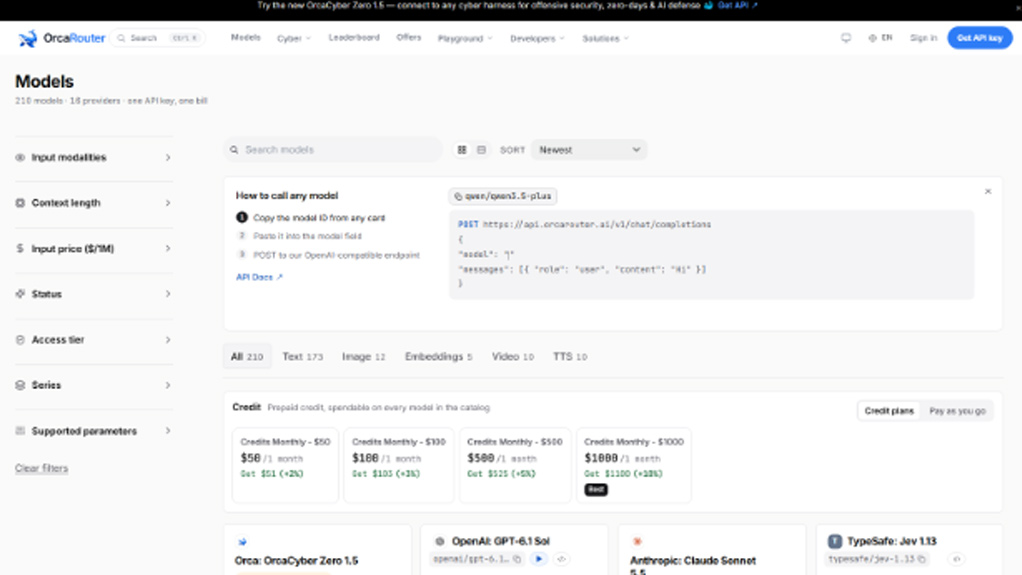
What that removes is a list of chores that scale with the number of vendors you call:
- one credential to store and rotate instead of one per provider;
- one billing relationship instead of a reconciliation spreadsheet across several invoices;
- one retry and failover path instead of a hand-rolled wrapper per API shape;
- one request log, one spend view, one place where the model name and the price sit beside each other.
The point is not that any single chore is hard. The point is that seven copies of an easy chore is a week of work per quarter, and the catalogue collapses the seven into one before you write a line of adapter code.
What enters the catalogue, and when
Freshness is a catalogue feature, not a footnote. Frontier models — the GPT, Claude and Gemini families — typically land in the catalogue within 24 hours of the vendor’s release, and open-weight models (Llama, Mistral, Qwen, DeepSeek) usually within a few days, depending on upstream availability [VENDOR]. If your product is judged on how quickly you can offer the newest model, that interval is the number that matters, not the row count.
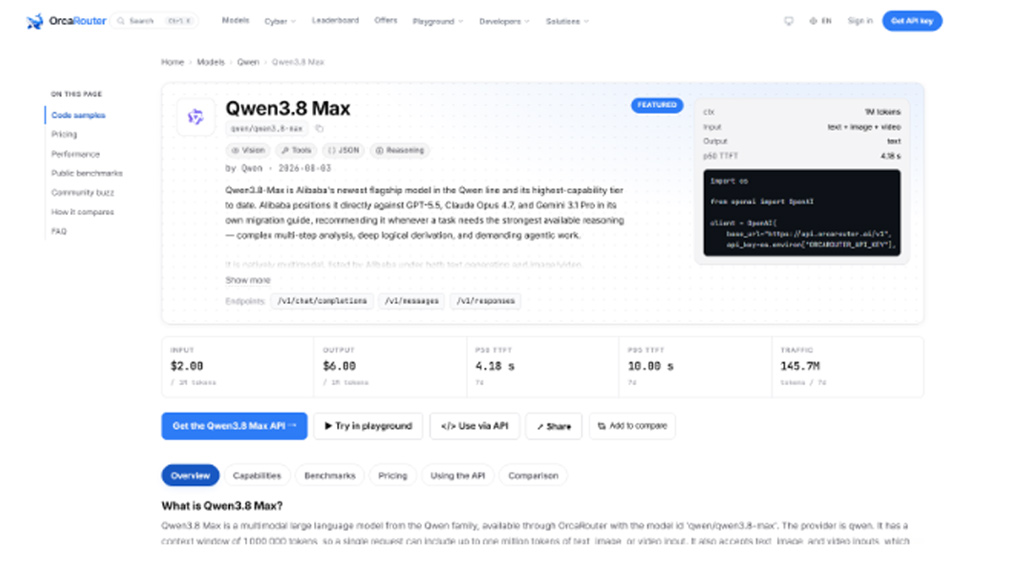
The featured row names the current front of the shelf: `claude-opus-4-7` for Anthropic frontier reasoning, `gpt-5.5` as the OpenAI flagship, `gemini-3.1-pro-preview` for long-context multimodal work, `claude-sonnet-4-6` as the balanced pick, `deepseek-v4-pro` for DeepSeek reasoning, `qwen3.6-plus` for multilingual work, `kimi-k2.6` with its 256K context, and `seedance-2.0` on the video side [VENDOR]. Nothing about that list is a ranking; it is a sample of how wide the shelf is.
Prices that are the upstream rate
Per-token prices in the catalogue reflect the live upstream rate, and nothing is added on the way through — what the table shows is what the account is billed at request time [VENDOR]. The OpenAI page makes it concrete rather than slogan-shaped: GPT-5.2 Pro at $21.00 per million input tokens and $168.00 per million output tokens, with `openai/text-embedding-3-small` the cheapest OpenAI row at $0.02 per million input and the zero-markup claim stated in the same breath [VENDOR].
Sizes differ sharply by vendor, which is the practical case for one catalogue instead of several browser tabs: Google lists 30 models on its provider page, Qwen 27, Anthropic 13, Z.ai 10, DeepSeek 9, Grok 5, Kimi 4 [OURS, read 2026-10-14]. The model pages behind the catalogue also carry a 0–10 quality score; that score is our own composite, built by scoring each model across our own quality dimensions, not a third-party benchmark, and it is deliberately coarse.
The modality tabs change what a catalogue is
Above the table, the modality tabs scope the catalogue to text, image generation, audio for speech in and speech out, or video, and the sidebar stacks provider, context-window and price filters on top of that [VENDOR]. That matters because what is being catalogued is no longer only a list of chat endpoints. The strip along the bottom of the catalogue shows the spread in raw ids: a cyber model, a flagship reasoning model, a multilingual model, a validation model and a video generator all sitting in one table.
Once modalities mix, the unit of price mixes with them. Most rows are priced per million tokens. Some rows are priced per request instead, and a per-request row is billed per request — a `$0.00 per request` row is a per-request row, which is a different thing from free tokens, and reading it as the latter will make your estimate wrong in the direction that hurts.
Reading a context window in the right vocabulary
One habit saves real trouble: this site quotes context windows in two vocabularies. The pricing-table column reads 1M. The FAQ prose on several provider pages spells the same family’s window out as 1050K, 1048K or 1000K. Pick the vocabulary of the page you are on and stay inside it. Do not blend the table column and the FAQ prose into one sentence, because they are not the same string, and anyone who checks your arithmetic against the page will see it immediately.
Where one key does not help
The honest half of the story, in the same list form:
- It does not make a weak model strong. If a row is not good enough for your task, routing it through one endpoint does not change the weights.
- It does not remove a vendor’s rate limits. Those belong to the upstream provider and follow you through any gateway.
- It does not equalize capabilities. A model without vision still has no vision, and a 32K window is still a 32K window.
- It does not make the choice for you. 200+ rows is 200+ decisions you still have to make, and the catalogue only makes the comparison cheaper.
- It does not expose a vendor feature outside the compatible surface. If something is not expressed in the request, one key does not conjure it.
The takeaway
A catalogue of 200+ models is not a claim about any one of them. It is a claim about the shape of an integration: that the per-vendor work — credentials, adapters, retries, invoices, logs — can be paid once instead of seven times, at the provider’s own published rate, and that a new model can arrive within 24 hours without a sprint. Read the row count as capacity and the key count as the actual product. Then read the price column carefully, because it is the provider’s number and not the catalogue’s, and read the context column knowing which vocabulary you are quoting.
Sourcing note: the model counts, vendor list, featured models, catalogue ids, 24-hour and few-day freshness windows, the $21.00/$168.00 GPT-5.2 Pro rates, the $0.02 embedding rate and the zero-markup statement are the vendor’s own published figures as read from the catalogue and the provider pages on 2026-10-14 [VENDOR]. Per-vendor model counts and the 0–10 quality scores are ours, read from our own pages on the same date; the quality score is our own composite built from our own quality dimensions and is not a third-party benchmark [OURS]. No third-party benchmark figures are used in this article. Read 2026-10-14.

The OrcaRouter Model Catalogue: 200+ Models Behind One OpenAI-Compatible Key

When Does a Tree Need Professional Attention?

Havrenn & Co. Brings the Rich Texture of Suede Back Into Focus

What the Diagnostic Process for Recurrent Pregnancy Loss Involves and Why It Matters to Work with a Specialist

IFRS vs Ind AS 20: Key Differences Every Indian Accountant Should Know

Why Semi-Detached Homes Are Performing Differently Across the Bexley Property Market

Easy Ways to Practice Self Care

6 Ways to Keep Your Car Running When Moneys Tight

Madeira in Autumn: A Slower, Warmer Way to Experience the Island

What You Actually Hand Over When You Book a Trip Online
What the Diagnostic Process for Recurrent Pregnancy Loss Involves and Why It Matters to Work with a Specialist
Why Semi-Detached Homes Are Performing Differently Across the Bexley Property Market
IFRS vs Ind AS 20: Key Differences Every Indian Accountant Should Know
6 Ways to Keep Your Car Running When Moneys Tight
Easy Ways to Practice Self Care
Havrenn & Co. Brings the Rich Texture of Suede Back Into Focus
When Does a Tree Need Professional Attention?
The OrcaRouter Model Catalogue: 200+ Models Behind One OpenAI-Compatible Key
The OrcaRouter Model Catalogue: 200+ Models Behind One OpenAI-Compatible Key
When Does a Tree Need Professional Attention?
Havrenn & Co. Brings the Rich Texture of Suede Back Into Focus
What the Diagnostic Process for Recurrent Pregnancy Loss Involves and Why It Matters to Work with a Specialist
IFRS vs Ind AS 20: Key Differences Every Indian Accountant Should Know
Why Semi-Detached Homes Are Performing Differently Across the Bexley Property Market
Easy Ways to Practice Self Care
6 Ways to Keep Your Car Running When Moneys Tight
Madeira in Autumn: A Slower, Warmer Way to Experience the Island
What You Actually Hand Over When You Book a Trip Online
-

 Biography8 months ago
The Emotional Journey of Joanne Schieble Simpson, Steve Jobs’ Biological Mother
-

 News7 months ago
Jamal Adeen Thomas – Everything You Should Know About Clarence Thomas’ Son
-
 Blog4 months ago
What Is Sotwe? Everything You Need to Know Before Using It
-

 Biography8 months ago
Meet Theo Ressler: Everything You Know About Jami Gertz’s son