Have you ever wondered why some Web3 projects take so long to make simple decisions? A proposal gets posted, people discuss it for days, voting stays open for weeks, and sometimes hardly anyone votes at all. By the time a decision is made, the market may have already changed. This is one of the biggest problems many DAOs face today.
That is where quack ai governance comes in. It is a system that combines artificial intelligence and blockchain technology to help DAOs make decisions faster and more smoothly. Instead of depending only on people to vote on every proposal, the platform uses AI agents that can help analyze information, support voting, and carry out approved actions.
Many people believe that governance is one of the hardest parts of Web3. Building a project is one thing, but managing thousands of members and making fair decisions is another challenge completely. When participation drops and important updates get delayed, growth can slow down.
Quack ai governance was created to solve these problems. It aims to reduce delays, increase participation, improve transparency, and make governance work at the same speed as modern blockchain projects. In this guide, we will explore how it works, why it matters, and how AI may change DAO voting forever.
What Is Quack AI Governance?
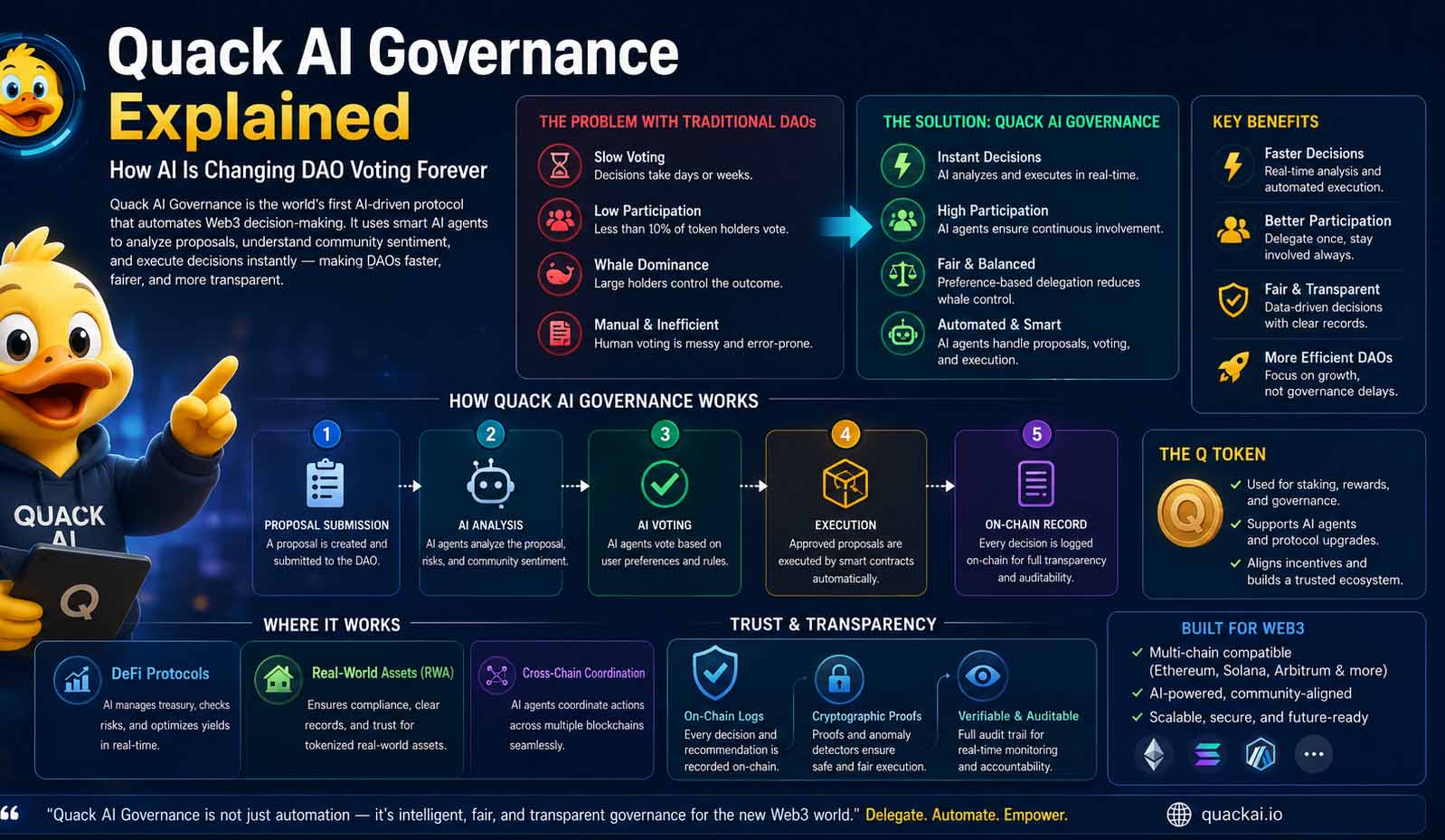
Quack ai governance is an AI-powered governance system designed for DAOs and other Web3 communities. Its main goal is to automate many parts of the decision-making process while keeping everything visible and easy to track on the blockchain.
In a normal DAO, members must read proposals, study the details, discuss ideas, and then vote manually. While this sounds fair in theory, it often becomes difficult when the community grows larger. Many members become inactive or simply do not have enough time to review every proposal.
Quack ai governance introduces smart AI agents that can help with these tasks. These agents can study proposals, review community discussions, analyze available data, and help make governance more efficient. The idea is not simply to speed things up, but also to make governance easier for everyone involved.
You can think of it as a smart helper working alongside the community. Instead of replacing people completely, the system is designed to support better participation and faster decisions. This allows projects to focus more on growth and less on governance delays.
Another important goal is scalability. As a DAO becomes larger, governance often becomes harder to manage. Quack ai governance tries to solve this by creating a system that can continue working efficiently even as the community expands.
What Is a DAO and How Does Voting Work?
Before understanding quack ai governance, it helps to understand what a DAO is. DAO stands for Decentralized Autonomous Organization. It is a community-led organization where members help make decisions instead of relying on one central authority.
Most DAOs use tokens as voting power. People who hold tokens can vote on proposals that affect the future of the project. These proposals may involve funding, new features, partnerships, treasury management, or community rules.
Imagine a group of people managing a large online project together. Every important decision must be voted on by members. While this gives everyone a voice, it also creates challenges when thousands of people are involved.
Voting periods can last several days or even weeks. Discussions may continue for a long time before a final decision is reached. In fast-moving industries such as decentralized finance, these delays can become a serious problem.
The goal of DAO voting is to create fairness and community control. However, in practice, participation often falls and governance becomes slower than many people expect. This is one of the key issues quack ai governance aims to address.
Why Many DAOs Have Voting Problems
One of the biggest issues facing DAOs is low participation. Many reports show that only a small percentage of token holders actively vote. In some cases, fewer than ten percent of members take part in governance decisions.
There are several reasons for this. Reading proposals takes time. Understanding technical details can be difficult. Busy members may not have enough time to review every discussion before casting a vote.
This creates a problem known as voter fatigue. People become tired of reviewing proposal after proposal. Over time, participation drops and important decisions are left in the hands of only a small group of voters.
Another challenge is speed. Markets can change within hours, yet governance votes may take weeks to complete. During that time, opportunities can disappear and risks can increase. Projects may struggle to react quickly when conditions change.
There is also the issue of large token holders, often called whales. Because voting power is usually tied to token ownership, people with very large holdings can sometimes have more influence than the rest of the community. This can create concerns about fairness and balance.
How Quack AI Governance Solves These Problems
Quack ai governance was designed to tackle these common DAO challenges. Instead of depending entirely on manual voting, it introduces AI-driven support throughout the governance process.
One of its biggest advantages is continuous participation. Traditional governance often slows down when members become inactive. AI agents can continue monitoring proposals and helping with governance tasks even when community members are offline.
The platform also focuses on faster decision-making. AI systems can review large amounts of information much more quickly than humans. This helps reduce delays and allows communities to respond faster to changing conditions.
Another benefit is improved consistency. Human decisions can sometimes be influenced by emotions, limited information, or personal interests. AI agents follow rules, analyze available data, and make recommendations based on predefined preferences.
The goal is not to remove people from governance. Instead, quack ai governance aims to create a better balance between human oversight and intelligent automation. This helps communities remain active, informed, and efficient.
How AI Agents Make Decisions
At the center of quack ai governance are AI agents. These are intelligent software systems that can perform governance-related tasks with limited human involvement.
When a proposal is submitted, AI agents can begin reviewing it immediately. They study the proposal details, examine related discussions, and look at available blockchain data. This helps them understand the possible effects of a decision.
The system can also monitor community sentiment. In simple terms, it looks at how members are reacting to proposals and discussions. This helps create a broader picture of community opinions before important decisions are made.
Risk analysis is another important feature. AI agents can review proposals and identify possible concerns before action is taken. This helps communities make more informed choices and avoid unnecessary mistakes.
Because AI agents work continuously, they can process information much faster than traditional governance systems. This allows quack ai governance to support real-time decision-making while still maintaining transparency and accountability.
Understanding the AI Delegation Model
One of the most important features of quack ai governance is the AI Delegation Model. This feature allows users to delegate their voting power to AI agents that match their preferences.
Think of it this way. Imagine you support a DAO but do not have time to read every proposal. Instead of becoming inactive, you can choose an AI agent to represent your voting preferences. The agent then participates on your behalf.
This creates a more active governance system. Even when users are busy, traveling, working, or sleeping, their preferences can still be represented through delegated AI agents.
The system works somewhat like hiring a trusted helper. You decide what values and goals matter to you. The AI agent then uses those preferences when reviewing proposals and participating in governance decisions.
Because participation remains active even when users are offline, the AI Delegation Model helps reduce voter apathy and improve engagement across the entire DAO community.
What Are Governance Certificates?
Another interesting feature mentioned in quack ai governance is Governance Certificates. These certificates are designed to give more people a chance to participate in governance.
Traditionally, governance power is closely linked to token ownership. People with larger holdings often have more influence over decisions. This can make smaller community members feel less involved.
Governance Certificates aim to create a different path to participation. According to the model, users can earn points through activity and engagement within the platform. Those points can then be converted into governance power.
This approach encourages community involvement instead of focusing only on token wealth. Active members who contribute value may gain a stronger voice in governance decisions over time.
Supporters believe this system can help make governance more inclusive and accessible. It gives more people a reason to participate and helps reduce the gap between large token holders and regular community members.
How Proposal Analysis Works
Before a vote even begins, quack ai governance uses a feature often called the Proposal Engine. This system is designed to review and analyze proposals before they reach the voting stage.
The Proposal Engine can read proposal documents, review discussions, and study live blockchain data. Instead of forcing users to sort through large amounts of information, the system helps organize important details into simpler insights.
For many DAO members, this can save a significant amount of time. Rather than spending hours researching every proposal, users can review summarized information and understand the key points more quickly.
The system also checks for possible risks and concerns. This early review process helps communities identify weak proposals and understand potential consequences before decisions are made.
By combining proposal analysis, risk checks, and community feedback, quack ai governance aims to make governance smarter, easier, and more informed.
How Quack AI Automates Actions
After a proposal is reviewed and approved, the next step is action. In many DAOs, this part can still be slow. A team may need to sign a transaction, release funds, update a rule, or send rewards by hand. This can create more delay.
Quack ai governance tries to make this part faster through smart contract actions. Once the rules are clear and the decision is approved, the system can help carry out the next steps. This may include moving funds, sharing rewards, or making planned changes inside the DAO.
This is useful because Web3 moves very fast. A DeFi project may need to change a risk rule quickly. A treasury may need to send funds to a builder. A community may need to update voting settings. If every step takes too long, the project can lose time.
The goal is simple. Quack ai governance does not only help with voting. It also helps the DAO move from decision to action. This makes governance feel less like a slow meeting and more like a working system.
Where Quack AI Governance Can Be Used
Quack ai governance can be useful in many parts of Web3. It is not only for one small type of project. It can help DAOs, DeFi apps, real-world asset projects, and groups that work across many blockchains.
One strong use case is DeFi. In DeFi, prices and risks can change very fast. A slow vote may not be enough when the market moves in minutes. AI agents can help study risk, watch data, and support faster choices.
It can also help with treasury management. A DAO treasury is like the money box of a project. AI can help review funding requests, study past results, and suggest how money should be used in a better way.
Another use case is real-world assets, also called RWA. This means things like real estate, goods, or other real items that are shown on the blockchain. These projects need clear records, checks, and trust. Quack ai governance can help by keeping decision logs and making actions easier to check.
Cross-Chain Governance Made Easier
Web3 does not live on one chain only. Many projects use Ethereum, Solana, Arbitrum, TON, and other networks. This can make governance harder because decisions may need to happen across many places.
Quack ai governance aims to make cross-chain work easier. Instead of managing each chain in a messy way, a DAO can use AI agents to help keep actions more connected. This is useful for large projects that work in more than one blockchain space.
For example, imagine a DAO that supports climate projects on different chains. It may need to vote, send funds, and follow goals across many networks. AI-driven governance can help keep these actions aligned.
This does not mean everything becomes magic or risk-free. Cross-chain work still needs strong safety checks. But a smart AI governance layer can make the work easier, faster, and more organized.
Trust, Safety, and Clear Records
A big question is simple: can people trust AI with governance? This is a fair question. If an AI agent makes a decision, users should be able to understand why it made that choice.
This is why clear records are very important. Quack ai governance uses blockchain records to make actions easier to check. Each decision can leave a trail, so the community can review what happened later.
The article also mentions cryptographic proofs. In simple words, these are special checks that help prove something happened in the right way. They can help make sure decisions are not hidden, changed, or faked.
This matters because AI can sometimes feel like a black box. People may worry that they cannot see what is happening inside. On-chain logs, clear records, and proof systems can help make AI governance more open and trusted.
The Q Token and Platform
The article also talks about the Q token. This token is linked to the Quack AI platform and may be used for staking, rewards, and governance support. Token holders may use it to support AI agents or take part in upgrades.
Staking can help create better behavior in the network. When users or validators put tokens at risk, they have a reason to act honestly. If the system is built well, dishonest actions can become costly.
The platform may also include an easy app or dashboard. This is important because many DAO tools are hard for normal users. A simple dashboard can help people set choices, follow AI agents, and understand decisions without needing deep tech skills.
For Quack ai governance to grow, ease of use is very important. If only experts can use it, participation may stay low. But if normal users can understand it, more people may join and take part.
Main Benefits of Quack AI Governance
The first big benefit is speed. Traditional DAO voting can take days or weeks. AI support can help review proposals faster, study risks sooner, and move decisions forward with less waiting.
The second benefit is better participation. Many people do not vote because they are busy or unsure. With AI delegation, users can still have a voice even when they are offline or do not have time to study every small detail.
Another benefit is fairness. Governance Certificates and preference-based voting may help reduce the power gap between large token holders and smaller members. This can make the system feel more open and more balanced.
Transparency is also a key benefit. With on-chain logs, audit trails, and proof systems, users can check what happened. This helps build trust, especially when AI agents are involved in important choices.
Possible Risks and Challenges
Even though quack ai governance has many strong ideas, it also has risks. AI tools are helpful, but they are not perfect. They can still make mistakes if the data is poor, the rules are weak, or the system is not watched properly.
Another challenge is trust. Some users may not feel comfortable giving voting power to AI agents. They may want to know how the agent thinks, what data it uses, and how it follows user choices.
Security is also very important. If a governance system controls money, votes, or smart contracts, it must be protected. A weak system could create serious problems for a DAO or DeFi project.
There may also be legal and rule-based questions. As AI and blockchain grow, governments may ask for more clear records and safer systems. This means AI governance tools must be built with care, checks, and strong rules.
Why It Matters for the Future of DAO Voting
DAO voting was created to give communities more power. But if people do not vote, or if only a few large holders control choices, the system does not reach its full promise. This is why better governance tools are needed.
Quack ai governance matters because it tries to fix the weak parts of DAO voting. It does this with AI agents, proposal checks, smart contract actions, and clear records. These tools can help DAOs work faster and more fairly.
In 2026, AI and Web3 are becoming more connected. More projects want systems that can act quickly, explain decisions, and support large communities. AI-powered governance may become a major part of that future.
Still, the best systems will not remove humans fully. Strong governance should mix human values with smart tools. AI can help with speed and data, while people can still guide goals, ethics, and community direction.
Final Thoughts
Quack ai governance is an interesting step in the future of DAO voting. It shows how AI can help Web3 communities make faster, clearer, and more useful decisions.
It solves many common problems, such as slow voting, low participation, voter fatigue, whale control, and delayed action. With AI agents, proposal analysis, Governance Certificates, and smart contract automation, the system gives DAOs a new way to work.
It can also help in DeFi, real-world assets, and cross-chain projects. These areas need speed, trust, and clean records. Quack ai governance tries to bring all of these things into one governance system.
The future of DAO voting will likely need both people and AI. People bring values and purpose. AI brings speed and support. Together, they can make Web3 governance more useful, more fair, and easier for everyone
(FAQs)
What is quack ai governance?
Quack ai governance is an AI-powered system for DAO voting and Web3 decisions. It uses AI agents to study proposals, support voting, and help carry out approved actions.
How does quack ai governance help DAO voting?
It helps by making voting faster and easier. Users can delegate voting power to AI agents, so they can still take part even when they are busy or offline.
What are AI agents in Quack AI Governance?
AI agents are smart software helpers. They can read proposals, check data, study risks, and act based on user choices and set rules.
What are Governance Certificates?
Governance Certificates are a way to give users more governance power through activity and platform use. They may help smaller users take part without needing large token holdings.
Is quack ai governance safe?
It aims to be safer by using on-chain records, smart checks, and cryptographic proofs. Still, like any AI and blockchain tool, it needs strong security and careful use.
What is the Q token used for?
The Q token may be used for staking, governance support, agent backing, and platform upgrades. It helps connect rewards, trust, and user action inside the system.
Can Quack AI Governance work on many blockchains?
Yes, the article says it is built for multi-chain use. It may help DAOs work across chains like Ethereum, Solana, Arbitrum, TON, and other Web3 networks.
Don’t miss these:
HCOOCH CH2 H2O Made Easy: Meaning, Uses, and Chemistry
Pann Choa Explained: What Every K-Pop Fan Should Know





 Biography7 months ago
 News6 months ago
 Blog3 months ago
 Biography7 months ago