Statistics is something we see in daily life without even noticing it. For example, when we compare results like what we expected and what actually happened, we are already thinking in a statistical way. The chi square test is a simple tool in statistics that helps us check these differences in a clear and proper way.
The idea behind chi square is very simple. It helps us compare “real results” with “expected results.” If the results are close, everything looks normal. If they are very different, then something interesting may be happening in the data.
In this article, we will learn chi square in a very easy way. We will talk about what it means, why it is used, its formula, types, examples, and where it is used in real life. Everything will be explained step by step in simple words.
We will also see how chi square helps in research, surveys, business, and daily decision-making. So by the end, you will clearly understand this topic without any confusion.
What Is Chi-Squars?
The chi square test is a method in statistics that helps us compare observed data and expected data. Observed data means the real numbers we get from an experiment or survey. Expected data means the numbers we think should happen based on a rule or idea.
In simple words, chi square tells us how different real results are from what we expected. If both values are very close, the result is normal. If they are very different, it means something unusual is happening in the data.
This test is mainly used with categorical data, which means data that is grouped into categories. For example, gender, age groups, color choices, or yes/no answers are all categorical data types used in chi square.
So, we can say that chi square is a way to check patterns and differences in grouped data in a very simple and structured way.
Why Chi-Square Test Is Used
The chi square test is used to find out if the difference in data is real or just due to chance. In many cases, data may look different, but that difference may not actually mean anything important. This test helps us understand that clearly.
Another reason to use chi square is to compare different groups. For example, we can check if boys and girls choose different subjects, or if different age groups like different products. It helps in making better decisions.
It is also used to check relationships between two things. For example, is there any connection between age and buying behavior? The chi square test helps answer this type of question in a simple way.
Because of these reasons, chi square is widely used in research, surveys, business studies, and even social science projects.
Simple Idea Behind Chi-Square Test
The basic idea of the chi square test is very easy to understand. It compares two things: what we observed and what we expected. Observed means what actually happened, and expected means what we thought would happen.
If both values are close, then there is no big change or problem. This means the data fits well. But if both values are far apart, then there is a strong difference, and we need to study it more carefully.
This simple idea helps researchers understand patterns in data. It also helps in checking if a theory or idea is correct or not. That is why chi square is very useful in statistics.
In short, chi square is just a way to measure the gap between reality and expectation in a very simple and clear way.
Chi-Square Formula Explained Simply
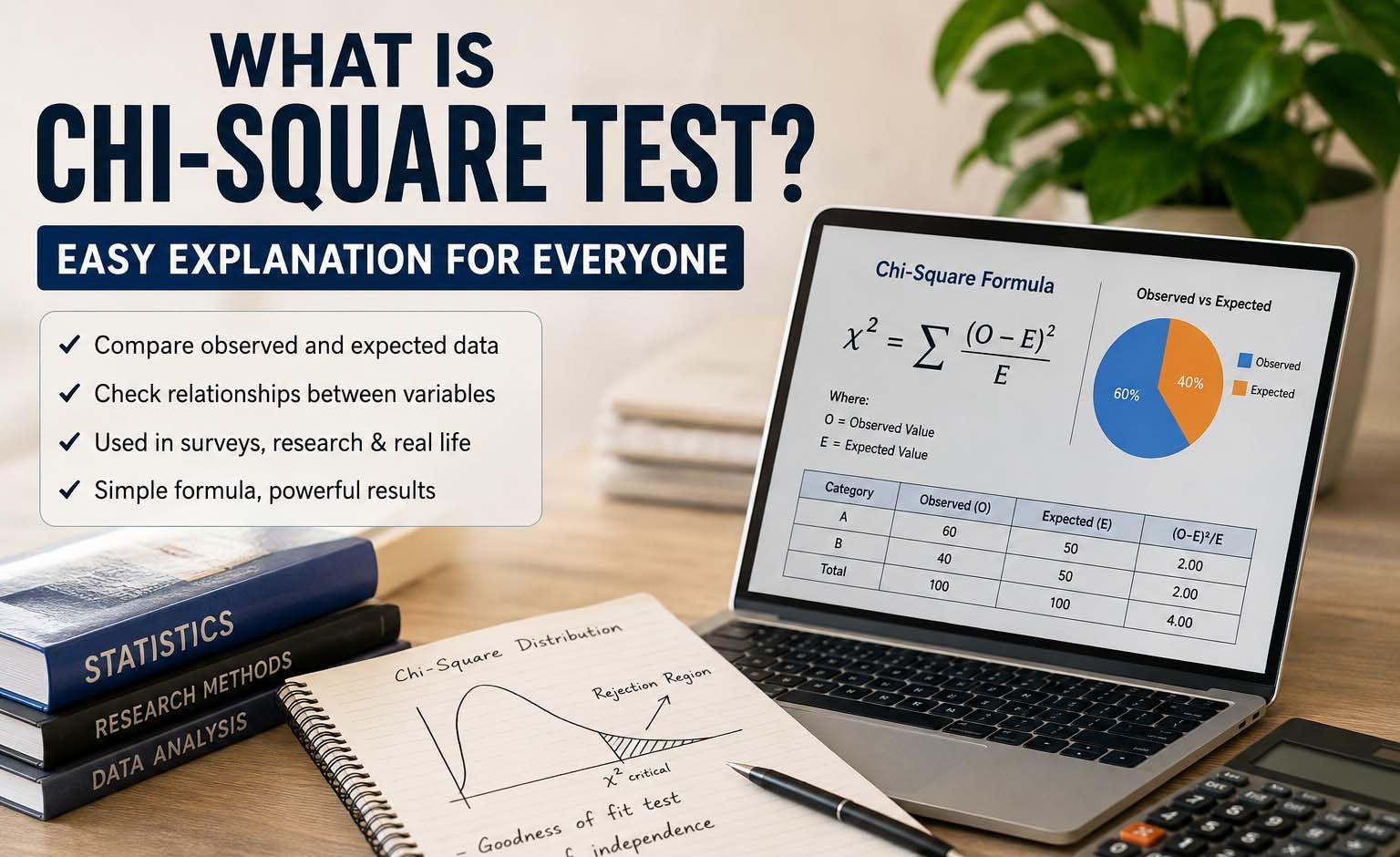
The formula of chi square looks like this:
χ² = Σ (O − E)² / E
This formula may look hard at first, but it is actually very simple. It is just a way to calculate how far observed values are from expected values.
Here:
-
O means observed value (real data)
-
E means expected value (expected data)
-
Σ means we add all results together
The formula checks the difference between O and E, squares it, and then divides it by E. This process is repeated for all data points, and then everything is added together.
So, the chi square formula is just a step-by-step way to measure differences in data in a proper and fair way.
Types of Chi-Square Tests
There are two main types of chi square tests. Each type is used for a different purpose, but both are based on the same idea of comparing observed and expected data.
The first type is the test of independence. This test checks whether two variables are connected or not. For example, it checks if gender and product choice are related or not.
The second type is the goodness-of-fit test. This test checks how well observed data matches expected data. For example, it can test if a coin is fair or not by comparing heads and tails results.
Both types are very important in statistics and are widely used in research, surveys, and experiments.
Chi-Square Test of Independence
The chi square test of independence is used to check if two things are related. It helps us understand if one variable affects another or not.
For example, we can check if gender has any effect on course selection. We compare the number of males and females in different courses and see if the pattern is random or not.
If the results show similar patterns, it means there is no strong connection. But if the patterns are very different, it may mean there is a relationship between the two variables.
This type of chi square test is widely used in surveys, marketing research, and social studies.
Chi-Square Goodness-of-Fit Test
The chi square goodness-of-fit test is used to check how well real data matches what we expect. It compares the observed results with a theoretical pattern or idea. If both are close, the data fits well and looks normal.
For example, think about a coin. We expect heads and tails to appear equally. If we toss it many times, we can use chi square to check if the results are close to 50/50 or not.
This test is also used in marketing and business. For example, a company may expect a certain age group to buy a product. The chi square test helps check if real buyers match that expectation or not.
So, this test is very helpful when we want to compare real-world data with an expected pattern in a very simple and clear way.
Real-Life Examples of Chi-Square Test
The chi square test becomes very easy to understand when we look at real-life examples. One common example is a coin toss. If a coin is fair, it should give almost equal heads and tails.
Another example is in schools. Teachers can check if boys and girls choose different subjects or not. The chi square test helps find out if the difference is real or just random.
In business, companies use chi square to understand customer behavior. For example, they can check if different age groups prefer different products or not.
These examples show how chi square is used in real life to understand patterns in simple and clear ways.
When to Use Chi-Square Test
The chi square test is used when we have categorical data. This means data that is grouped into categories like yes/no, male/female, or different age groups.
We use chi square when we want to compare observed data with expected data. It helps us see if there is a real difference or just random change.
It is also used when we have survey data or questionnaire results. These types of data often come in groups, so chi square works very well with them.
So, whenever we deal with grouped data and want to check patterns, the chi square test is a good choice.
Conditions for Using Chi-Square Test
There are some important rules before using the chi square test. First, the data should be random. This means every sample should be chosen fairly without bias.
Second, the observations should be independent. One result should not affect another result. This makes the chi square test more accurate.
Third, the sample size should be large enough. Small samples may give wrong or unclear results. Most expected values should also be above 5 for better accuracy.
These conditions help make sure the chi square results are correct and reliable.
Steps to Perform Chi-Square Test
The chi square test is done in simple steps. First, we make a table of observed and expected values. This helps us organize the data clearly.
Next, we use the chi square formula to calculate the value. We find the difference between observed and expected values and apply the formula step by step.
After that, we compare the result with a critical value. This helps us decide if the difference is important or not.
Finally, we accept or reject the idea we are testing. This is how the chi square test gives us a clear result.
Limitations of Chi-Square Test
The chi square test is very useful, but it also has some limits. One problem is that it can be affected by large sample sizes. Sometimes it may show a strong result even when the difference is small.
Another limit is that it cannot show cause and effect. It can only tell us if two things are related, not why they are related.
Also, the chi square test does not work well with small samples. It needs enough data to give correct results.
So, while chi square is powerful, it must be used carefully.
Uses of Chi-Square Test in Real Life
The chi square test is used in many real-life fields. In marketing, companies use it to understand customer choices and improve product targeting.
In education, teachers and researchers use chi square to study student behavior and performance patterns. It helps them understand group differences.
In social science, it is used to study population behavior, voting patterns, and survey results. It gives simple insights into complex data.
In business and research, chi square helps people make better decisions based on data patterns.
Final Thoughts
The chi square test is a simple but powerful tool in statistics. It helps us compare real results with expected results in a clear and structured way.
It is mainly used for categorical data and is very helpful in research, surveys, and business decisions. With chi square, we can understand patterns and relationships in data easily.
Even though it has some limits, it is still one of the most useful statistical tests. Once you understand the basics, chi square becomes very easy to use and very helpful in real-life analysis.
(FAQs)
What is chi-square test in simple words?
It is a test that compares real data with expected data to see if there is a difference or not.
Where is chi-square used?
It is used in surveys, research, business, education, and social studies.
What type of data is used in chi-square?
It is used for categorical data like gender, age groups, and yes/no answers.
What does chi-square tell us?
It tells us if two variables are related or if differences are just by chance.
Can chi-square show cause and effect?
No, it only shows relationships, not the reason behind them.
Is chi-square used in real life?
Yes, it is widely used in marketing, research, education, and surveys.
Don’t miss these:
ZeroGPT AI Checker: Can It Really Tell AI and Human Writing Apart?
Kinervus in 2026: Why More People Are Turning to It





 Biography6 months ago
 News6 months ago
 Blog3 months ago
 Biography6 months ago