Have you ever typed something into Google and felt like it knew exactly what you meant? You did not always use perfect words. You may have typed a short question, a half sentence, or even a messy phrase. Still, the search result felt helpful.
That happens because modern technology is becoming better at understanding meaning. It does not only look at single words anymore. It looks at the full idea behind those words. This is where context match becomes very important.
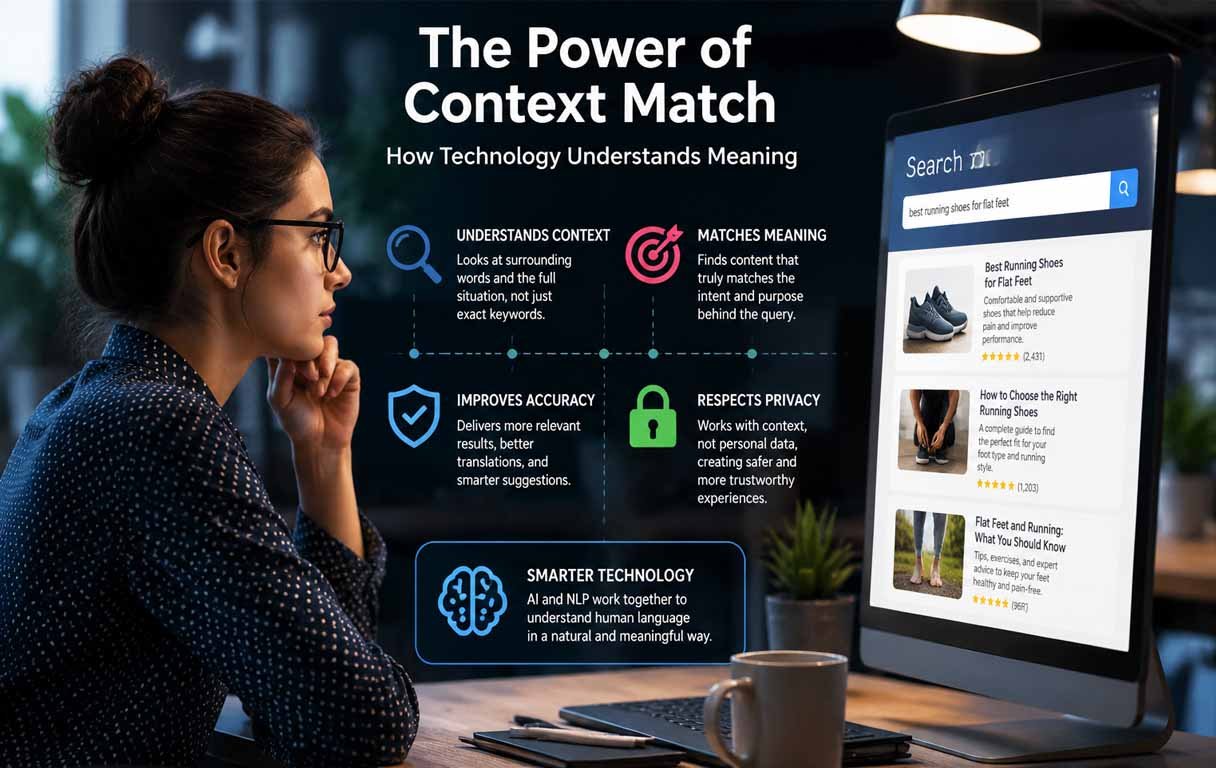
Context match is the smart way technology understands the meaning of something by looking at the words around it, the topic, the user’s need, and the place where the content appears. It helps computers know what a word or sentence really means.
In this article, we will explain context match in a very easy way. We will talk about how it works in translation tools, AI search, ads, SEO, and modern digital systems. We will also explain why context match is more useful than simple keyword matching.
By the end, you will understand why context match is not just a small tech idea. It is one of the biggest reasons why tools, apps, websites, and search engines feel smarter in 2026.
What Is Context Match?
Context match means matching something based on its real meaning, not just its exact words. It helps technology understand the full situation before giving an answer, showing an ad, finding a result, or reusing a translation.
Think about the word “run.” It can mean running in a race. It can mean running a business. It can also mean running a computer program. The word is the same, but the meaning changes with the sentence.
This is why context match matters. A simple keyword system may only see the word “run.” But a context match system looks at the nearby words and asks, “What does this word mean here?”
For example, if the sentence says, “I want to run in the park,” the meaning is about exercise. But if the sentence says, “Run the program again,” the meaning is about software. The words around it help the system understand the right meaning.
In simple words, context match helps technology stop guessing. It helps the system understand the real idea behind the text. That is why it is used in CAT tools, AI search, ads, SEO, and content systems.
Why Meaning Matters More Than Words
Words can be tricky. One word can have many meanings. One sentence can also mean different things in different places. This is why exact words are not always enough.
Take the phrase “check the light.” In a car repair guide, it may mean checking a headlight or warning light. In a home guide, it may mean checking a lamp. In a health article, “light” may even refer to a light meal.
If technology only matches the exact words, it can make mistakes. It may choose the wrong meaning. It may show the wrong result. It may reuse the wrong translation. This is the main problem with simple keyword matching.
Context match solves this by looking at the full picture. It checks the words before and after the main word. It checks the topic. It checks the place where the sentence appears. This gives the system a much better idea of the meaning.
This is also why modern search engines, AI tools, and translation software are moving away from simple word matching. They now focus more on meaning, purpose, and user intent.
How Context Match Works
Context match works by studying more than one word. It does not stop at the keyword. It looks at the full sentence, the nearby sentences, the page topic, the layout, and sometimes even the user’s search goal.
In simple words, the system asks a few questions. What is this content about? What does the user want? What do the nearby words mean? Is the person reading, buying, comparing, learning, or asking for help?
This is often done with tools like natural language processing, also called NLP. NLP helps computers understand human language in a better way. It helps them see meaning, tone, and intent, not only letters and words.
A context match system may also use semantic matching. This means it understands related ideas. For example, “gardening,” “plant care,” “yard work,” and “growing flowers” are different words, but they are connected by meaning.
So, context match is not magic. It is a smart process. The system reads the content, studies the meaning, checks the intent, and then chooses the most useful result, ad, answer, or translation.
Context Match in CAT Tools
Context match is very important in translation work. Translators often use CAT tools. CAT means Computer-Assisted Translation. These tools help human translators work faster, but they do not replace the translator.
A CAT tool uses something called Translation Memory. This is like a storage box for past translations. When a sentence has already been translated before, the tool saves the source text and the approved translation.
Later, if the same or similar sentence appears again, the CAT tool checks the Translation Memory. It then suggests the old translation so the translator does not have to start from zero.
This saves time and keeps the wording the same across large projects. It is very useful for manuals, websites, apps, legal files, software text, product pages, and company documents.
But there is one big point to understand. A sentence may look the same but mean something different in another place. This is why context match is so helpful in CAT tools. It checks not only the sentence but also the setting around it.
What Is a 100% Match?
A 100% match means the current sentence is exactly the same as a sentence already saved in the Translation Memory. The text matches word for word. At first, this sounds perfect.
But a 100% match only checks the sentence itself. It does not always check the full meaning. It may not know if the sentence is in a heading, a table, a list, or a different part of the document.
This can create a problem. The same sentence may need a different translation in another context. For example, “Start” can mean the start button in software. It can also mean the beginning of a race or a process.
So, a 100% match is useful, but it is not always fully safe. It tells the translator, “This sentence is the same.” But it does not always say, “This sentence is used in the same way.”
That is why translators and quality teams often still review 100% matches. They need to make sure the meaning fits the new place. This is where context match gives stronger confidence.
What Is a Context Match in Translation?
A context match in translation is often called a 101% match. Some tools also call it an ICE Match, which means In-Context Exact Match. This is stronger than a normal 100% match.
A context match means the sentence is exactly the same, and the surrounding context also matches. The tool checks more than just the words. It checks the place, the structure, and often the sentence that came before it.
For a true context match, the text must usually meet three main conditions. First, the sentence must be the same. Second, the document structure must match. Third, the previous sentence must also match.
This gives the CAT tool much more confidence. It is like saying, “This sentence is not only the same, but it also appears in the same kind of situation.” That makes the translation much safer to reuse.
Many CAT tools store this extra context as a kind of digital fingerprint. They save the sentence with its nearby text and layout details. Later, they use this fingerprint to check if the new sentence really appears in the same context.
Context Match vs Exact Match
An exact match and a context match may look similar, but they are not the same. An exact match checks the words. A context match checks the words and the meaning around those words.
A 100% exact match says, “The sentence is the same.” A context match says, “The sentence is the same, and the situation around it is also the same.” That small difference can make a big change in quality.
Imagine you have two signs with the word “Open.” One is on a shop door. The other is inside a software app. The word is the same, but the use is different. A simple exact match may not notice this.
A context match is smarter because it looks at where the word appears. Is it part of a button? Is it part of a sentence? Is it in a heading? Is it in a list? These details help protect the meaning.
This is why context match is more trusted than a normal exact match. It reduces confusion. It lowers the chance of using the wrong translation. It also helps teams work faster with more confidence.
Why Context Match Improves Quality
Quality is one of the biggest reasons people care about context match. When the system understands the setting, it can make better choices. This means fewer mistakes and cleaner results.
In translation, context match helps keep the right meaning. It helps translators avoid using a correct sentence in the wrong place. That is very important in fields like law, medicine, software, finance, and technical writing.
It also improves consistency. If the same approved sentence appears in the same context again, the tool can reuse it with high confidence. This keeps documents neat and clear from start to finish.
For project managers, this is very helpful. It means less review time, fewer corrections, and smoother delivery. It also helps large teams stay aligned when many translators work on the same project.
In simple words, context match helps people trust the result more. It does not remove the need for human care, but it makes the work safer, faster, and easier to manage.
Why Context Match Saves Time and Cost
Context match can also save time and money. When a segment has a strong context match, the translator does not need to spend as much time checking it. The tool already knows the sentence and its setting match.
This is why many translation projects give lower rates for context matches. A new sentence needs full work. A fuzzy match needs editing. A 100% match needs review. But a strong context match may need only a light check.
In many workflows, 101% and 102% matches may even be locked during pre-translation. This means the tool fills them in before the translator starts. The translator can then focus on new or risky text.
This is very useful in big projects with repeated content. Product manuals, software updates, legal files, and website versions often have many repeated parts. Context match helps teams avoid doing the same work again and again.
The result is simple. Projects can move faster. Review work can become lighter. Costs can go down. Quality can stay strong. This is why context match is not only a language feature. It is also a smart business tool.
Where the First Half Leads Us
So far, we have seen that context match helps technology understand meaning in a better way. It looks beyond exact words and studies the full situation. This makes it useful in translation, quality checks, cost control, and digital tools.
We also learned that a 100% match is not always enough. It only means the words are the same. A context match gives more trust because it checks the sentence, the structure, and the surrounding text.
I11. What Is Perfect Match?
Now that we understand context match, it is easier to understand Perfect Match. In many CAT tools, Perfect Match is shown as a 102% match. It is even stronger than a normal context match.
A Perfect Match does not only check the Translation Memory. It often checks an old approved bilingual file. This means the tool compares the new file with an older translated file that was already finished and approved.
This is very useful when a company updates a document. Maybe only a few lines changed. The rest of the file is the same. Perfect Match helps find the parts that did not change at all.
For example, a software company may update a user guide every year. Most of the guide may stay the same. Perfect Match helps reuse the old approved translation with very high trust.
This saves a lot of time. It also protects the old approved text from being changed by mistake. That is why Perfect Match is very useful in software, legal files, manuals, and large company documents.
Context Match, Perfect Match, and Fuzzy Match
To understand translation tools better, we should also talk about fuzzy matches. A fuzzy match means the sentence is close to an old sentence, but it is not exactly the same.
For example, one old sentence may say, “Click the blue button to continue.” A new sentence may say, “Click the green button to continue.” These sentences are close, but one word is different.
A high fuzzy match may need only a small change. A medium fuzzy match may need more edits. A low fuzzy match may need a lot of work from the translator.
So, the match levels are like a ladder. A fuzzy match gives a helpful start. A 100% match gives the same sentence. A context match checks the same sentence and its place. A Perfect Match gives the highest trust.
This helps translators and project managers plan better. They can see which parts need full work, which parts need review, and which parts can be reused with more confidence.
Context Match in AI Search
Context match is not only used in translation. It is also very important in AI search. In 2026, search tools are much smarter than old keyword systems.
Before, search engines often focused on exact words. If you searched “best shoes for walking,” they looked for pages with those words. Now, they also try to understand what you really need.
Maybe you want soft shoes for daily walks. Maybe you want shoes for foot pain. Maybe you want shoes for older people. A smart search system studies the full meaning behind your words.
This is why context match matters in search. It helps search tools give better answers. It helps them understand the topic, the intent, and the kind of help the user wants.
So, good content today should not only repeat keywords. It should answer the real question clearly. It should match the user’s need, not just the user’s words.
Context Match in SEO
Context match has changed SEO in a big way. SEO is no longer only about putting the same keyword again and again. That old style can feel forced and weak.
Today, search engines look for helpful content. They want pages that explain the topic fully. They want clear answers, useful examples, and strong topic coverage.
This means writers should use related words naturally. For context match, related ideas include user intent, meaning, semantic search, NLP, AI search, keyword meaning, and content relevance.
A good article about context match should explain the full topic. It should cover translation, CAT tools, Translation Memory, 100% match, 101% match, Perfect Match, ads, AI, and search.
When content explains the full idea in a natural way, search engines can understand it better. Readers also stay longer because they are getting real help.
Context Match in Advertising
Context match is also very useful in advertising. In simple words, it helps show ads that fit the content someone is reading right now.
For example, if someone is reading an article about healthy food, they may see an ad for a healthy snack or meal plan. The ad fits the page topic, so it feels more natural.
This is different from old tracking ads. Old ads often followed people around the internet based on their past activity. Many people found that annoying and uncomfortable.
Context match is better for privacy because it does not always need personal tracking. It can work by reading the page, topic, tone, and meaning of the content.
This is why many brands like contextual advertising. It can feel more helpful, less annoying, and safer for users. It also helps brands place ads in better and more fitting places.
Why Context Match Helps Privacy
Privacy is one reason context match has become more popular. People want useful online experiences, but they do not always want to be tracked everywhere.
Context match gives companies another way to show useful content or ads. Instead of asking, “Who is this person?” the system asks, “What is this page or search about?”
That small change is very important. It means the system can match content without needing deep personal history. This can make the web feel safer and more respectful.
Of course, not every system works the same way. Some tools may still use extra data. But the main idea of context match is much more privacy-friendly than old behavior tracking.
In 2026, this matters even more. Users care about trust. Brands also care about safe data use. Context match helps both sides meet in a smarter way.
Problems with Context Match
Context match is powerful, but it is not perfect. Sometimes, technology can still misunderstand meaning. This often happens when the content is funny, sarcastic, or very unclear.
For example, an article may joke about a bad product. A weak system may only see the product name and show an ad for that same product. That would not feel right.
Some topics are also harder to understand. Medical, legal, finance, and technical topics often need special knowledge. A basic system may not understand them well enough.
Context match can also be harder across many languages. Words, tone, and culture can change from one language to another. This is why human review is still important.
So, context match helps a lot, but it should not be seen as magic. It works best when strong tools, clean data, and human care work together.
The Future of Context Match
The future of context match looks very exciting. Technology is moving toward systems that understand more than text. This is often called multimodal understanding.
In simple words, future tools may look at text, images, video, audio, layout, and user need at the same time. This can help them understand meaning much better.
For example, an AI tool may read an article, study its images, understand the video on the page, and then decide what the page is really about.
This can improve search, ads, translation, learning tools, customer support, and business systems. It can make online results feel more useful and more human.
But the goal stays the same. Context match is all about understanding meaning. The better technology understands context, the better it can help people.
Final Thoughts
Context match is a simple idea with a big impact. It helps technology understand what words really mean by looking at the full situation around them.
In translation, context match helps improve quality, save time, and reduce repeated work. In search, it helps users find better answers. In ads, it helps show more useful and fitting messages.
The main lesson is clear. Words alone are not always enough. Meaning matters. Setting matters. User intent matters. That is why context match has become so important in 2026.
As AI, search, SEO, translation tools, and ads keep improving, context match will become even more useful. It is one of the key ways technology is learning to understand people better.
(FAQs)
What is context match in simple words?
Context match means matching something by its real meaning and setting. It does not only look at exact words. It checks the nearby words, topic, and full situation.
Is context match the same as keyword matching?
No. Keyword matching looks for exact words. Context match looks at meaning, user intent, and the full topic. This makes it smarter and more useful.
What is context match in CAT tools?
In CAT tools, context match means a sentence matches an old saved sentence and also appears in the same kind of place. It helps translators reuse text with more trust.
What is the difference between 100% match and context match?
A 100% match only means the sentence is the same. A context match means the sentence is the same and the surrounding context also matches.
What is Perfect Match?
Perfect Match is often a 102% match. It usually compares a new file with an old approved bilingual file. It is useful for updated documents and version control.
Does context match help SEO?
Yes. Context match helps SEO because search engines now care about meaning and user intent. Helpful content that answers the full topic can perform better.
Is context match useful in advertising?
Yes. Context match helps show ads that fit the page topic. This can feel more natural and can also support better privacy than old tracking ads.
Don’t miss these:
UnitedWiFi Explained: How to Stay Online During Your United Flight
Active Cornering Enhancement Explained: The Smart System That Keeps Your Car Stable





 Biography7 months ago
 News6 months ago
 Blog3 months ago
 Biography7 months ago